- Today
JERK Report #37 Advertising to AI Agents
For many years I have held a project management certification from the Project Management Institute, PMI, because it is sometimes required to get a contract. PMI tends to be conservative in its guidance, including on AI adoption. So I was surprised this week to see PMI and Ally Bank among the first organizations running ads for AI agents on Time magazine's webpages.
We have been writing for algorithms and for people for a while, but ads written only for agents and invisible to humans are new.
Position
Four kinds of ads now exist. Figure 1 shows where each one sits and who sees it.
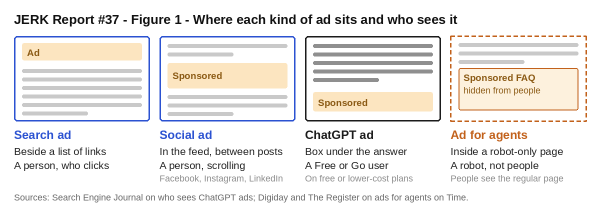
ChatGPT began piloting ads on February 9, 2026.
On August 31, OpenAI said ChatGPT ads had reached a $1 billion annualized run rate in less than 200 days. Annualized run rate means recent monthly revenue times twelve. That does not mean they have collected $1 billion.
Graphite and Similarweb studied more than 98,000 ads and 8,000 landing pages. By September, 43% of ad-eligible U.S. ChatGPT users had seen an ad. Click rates rose 112% between March 30 and September, by their chart. Most of the rise came by late June. Ads early in a conversation got more clicks. Most advertisers sent clicks to five or fewer of their own pages.
Velocity
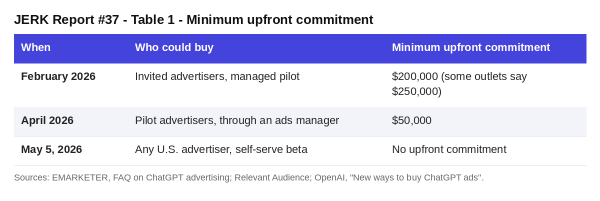
The price of entry for ChatGPT ads fell. Table 1 shows how.
The number of advertisers rose too, but no one counts them the same way. Table 2 shows four counts from four counters.
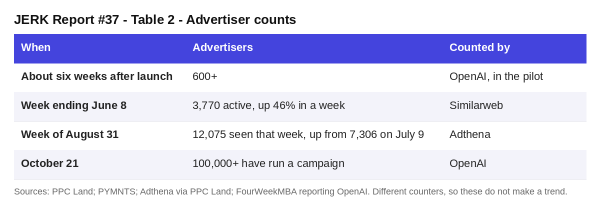
Do not chain these into a trend. OpenAI's 100,000 counts every advertiser that ever ran a campaign. It is not the number running now. Sensor Tower counted about 1,200 U.S. advertisers spending during August. Adthena saw 12,075 advertisers in its sample for the week of August 31. Different samples, different periods, different counts.
No one has published a churn rate. PPC Land's summary of the Graphite and Similarweb report describes a buyer pool "in which many advertisers appear for a few weeks and then vanish." The evidence is thin. Graphite picked 16 leading advertisers to show different paths. Four, including Zapier and SAP, were gone from its sample by mid-August. That is not an exit rate. The report's own verdict: "brands are still in experimentation mode."
Launch pricing was about $60 per 1,000 ad views. That price is called CPM, cost per mille. Mille is Latin for thousand. It prices 1,000 views, not clicks. Since May 5, advertisers can also pay per click.
Table 3 compares ChatGPT ads with the ads most businesses already buy. Conversion rate is the share of clicks that become a lead or a sale.
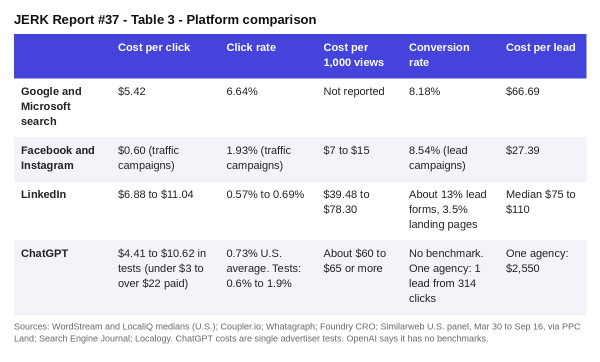
By these studies, a ChatGPT click costs about what a Google click costs, and ads are clicked about a tenth as often. The studies differ in sample and period, so read that as context. OpenAI says it has no performance benchmarks yet.
Acceleration
Acceleration asks whether the change is speeding up or slowing down. It takes three readings in a row. Here is what the available data lets us estimate.
The revenue run rate grew faster over the later interval. Counting launch as zero, ChatGPT ads ran at $100 million a year six weeks in. On August 31 they ran at $1 billion, about 23 weeks later. That is about $72 million of yearly pace added a month, then about $170 million a month. The dates are approximate and nothing shows the path between them. Self-serve, with no upfront commitment, opened in between.
Advertiser counts rose, fell and recovered. Adthena counts unique advertisers weekly. From July 9 to August 10 it gained about 1,200 advertisers a week, to 13,009. Then it lost about 1,500 a week, down to just over 10,000 by the week of August 24. In the week of August 31 it gained about 2,000, to 12,075. Overall it was up about 65% from July 9, but not in a straight line. Adthena does not explain the dip.
The early rise in click rate became uneven. In the first 12 weeks from March 30, the Similarweb chart, as read by PPC Land, shows the rate gaining about 0.8 percentage points, to about 1.2%. In the next 12 weeks it lost about 0.2 percentage points, to about 1.0%.
The ad business grew over these periods. Advertiser participation and click rates followed less even paths. These studies do not yet explain how well the advertising on ChatGPT will work over time.
What the ads have earned
Published results on ChatGPT ads are limited and mixed. In Table 4, two of seven advertisers report gains.
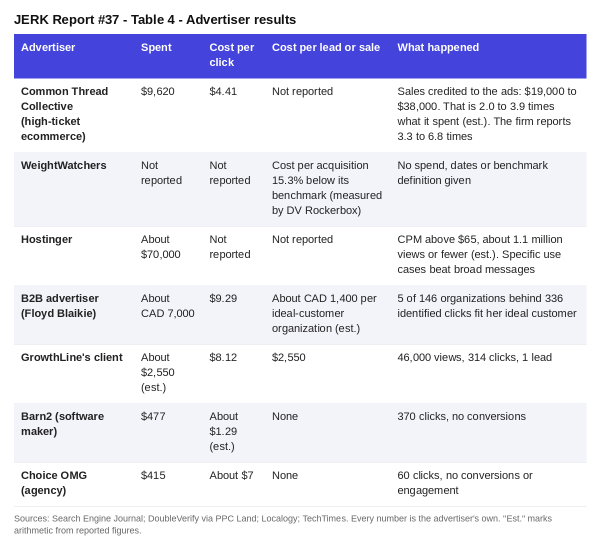
Another agency, Cleverly, saw OpenAI report 57 clicks while Google Analytics recorded fewer than 20 visits. After OpenAI added an automated bid strategy in late August, Common Thread's Evan Engler reported one client's click rate up 108% on day one.
Are advertisers making money? Mostly, no one can say yet. Few have published sales results. Also revenue is not profit. Say 40% of each sale is left after your other variable costs, before advertising. Then you need 2.5 times your ad spend back in sales just to break even before fixed overhead. One benchmark puts the median return on Meta ecommerce ads at about 1.9 times. At a 40% margin, that is under break-even. Common Thread's attributed sales are the strongest result in Table 4. Two others reported no conversions at all.
So far the results do not show a payoff most businesses can count on. Also, an Ipsos survey published February 4 found that 63% of Americans think ads in ChatGPT responses will make them trust the results less.
Jerk signal
Jerk is the change in acceleration, the earliest warning. The signal from ChatGPT ads is still too noisy to get a jerk reading. This week's signal is not a number. It is a new category: an ad that bypasses humans.
In late July, Time magazine began serving ads to AI agents with the ad company Mobian. Ally Bank and PMI were among the first buyers. Time and Mobian say it is the first publisher to do this, and more are being lined up.
The ads are sponsored FAQs, labeled as sponsored, on plain-text copies of Time's pages. People see none of it on the regular page. Ally's block has seven questions. PMI's has nine. "What bank is built for life today?" is answered with Ally's own slogan.
Why would a publisher do this? Because the visitors are changing. Time's chief operating officer says bots outnumber people on its pages on most days.
Does it work? Time says its own lift study shows uplift, and has not published figures. On August 11, Digiday reported that Perplexity said it had blocked the ads from its index and called them deceptive. I have not found a public policy from Google, OpenAI or Anthropic on these blocks. We don't know how this will pan out.
Business Insider reported that Ally's CMO, Andrea Brimmer, said visitors from AI platforms are 3.5 times more likely to open an account than visitors from search. That led Ally to experiment with ads for AI agents. It is also why people do AEO.
Answering buyer questions is what we do in our AEO working group. This ad format goes upstream. It puts a brand's answer on someone else's page, where the agent reads it.
Text-only pages
Time's ads ride on plain-text copies of its pages. A text-only copy drops the design, images and menus, so an AI can read it more easily. Time began converting its pages in June.
It works like the early mobile web. Sites sent a phone-sized page to phones and the full page to computers. Here the server sends the plain-text page to AI crawlers and the full page to people.
Does it help? No one knows yet. Digiday says the jury is still out. Google's John Mueller called converting pages for bots "a stupid idea". One site owner logged about 1,400 AI requests for his text pages over 44 days and could not say whether visibility improved.
The risk is cloaking. Google's rule is about giving bots materially different information to influence rankings. A simpler format with the same information is not that. BCG X's Rob Derow raised it about Time's ads. If you try a text-only copy, keep its substance the same as the page people read. Cloudflare offers it as a setting on paid plans. Mobian says about 15% of brands have text-only pages, and Time is pitching those brands first.
What this means for a small business
• If you run ads, know your break-even. Judge any channel by sales, not clicks. Know whether your business needs to recover advertising costs on the first sale or can afford a longer payback.
• The top of the funnel is moving upstream. People get answers without clicking, and since AI can help buyers form a shortlist before they visit your site, make sure your pages answer the questions that shape that shortlist.
• Own what you can. Ads rent attention. Your email list, your referrals and your own pages stay yours when prices and platform rules change. Dial your site to your buyers' needs and questions, in the words they use, in the version people see. Then check whether an AI can understand your offer.
• ChatGPT ads and AI agent ads are early. Agent ads are available from multiple providers. Vendors report gains in AI visibility, but those results do not establish reliable additional sales.
• Text-only copies of your pages are not yet essential. If your host offers one, it is cheap to test.
Five minute practice
Paste this into your favorite AI tool:
Look at my website [URL]. Based only on its content, tell me who you think my buyers are and what questions they come to an AI tool looking to answer.
If that doesn't match what you expected and you want to go deeper, join the next AEO Workshop. Also, later this week I will give you a sneak peek at the type of reports the AEO working group sees each week.
Check out the Jerk Report,
The JERK Report is a weekly signal read for small business owners. One signal. Four layers. A five-minute practice. Every Monday. From Rose Thun at Design Rosetta