- Jul 28
JERK Report #24 Twenty-Two Metrics Is Zero Metrics
Two days after last week's JERK workshop, a participant showed me her dashboard.
She'd done everything right. Took the framework home, ran it through two different AI models, mapped internal signals against external ones, buying-cycle stages, thought leadership angles, category definition. Twenty-two metrics, each with a reason to exist.
Then she said "I do not need 22 metrics".
She's right, and the reason why is this week's report.
The instrument problem
Last week I tried to run a jerk read on the VIX — the market's fear gauge. I couldn't. Not because the framework failed, but because the data wouldn't hold still long enough to give a deep read. Position, sure. Velocity, barely. Acceleration and jerk, no.
Same story with AI search optimization. Our working group has met weekly for seven months, and the honest finding is that the rules change faster than any single metric can settle. You can't take the fourth derivative of a number that keeps being redefined.
The most-watched number in America
Two days after the Workshop member showed me her 22 metrics, I went looking for the opposite case. One metric. Watched by everyone, deeply, for a century, The Consumer Price Index.
She had too many instruments. The country has one common instrument that is losing its depth.
Your raise is negotiated against CPI so are lease escalators, Social Security and SNAP.¹Here is what happened to the instrument over the past 18 months, read as a stack.
Position. The CPI is built from prices collected at about 23,000 stores and service businesses, plus rents from about 40,000 landlords and tenants.² That is the instrument as designed. Today it runs with holes. When a price is missing, BLS fills it by imputation. An estimate stands in for a measurement.
Velocity. The estimates themselves are weakening. When BLS imputes a price, the preferred method uses prices from the same category in the same city. The fallback reaches across regions. In May 2025, 30 percent of imputations used the fallback. By September, 40 percent. It has stayed near that level every month since.³The holes are being patched with material from farther and farther away.
Acceleration. The cuts are compounding. In April 2025, BLS stopped collecting prices entirely in Lincoln, Nebraska and Provo, Utah. In June, Buffalo.⁴ Then October 2025 vanished. The shutdown stopped collection, and BLS confirmed the data cannot be collected after the fact. There is no October CPI. There never will be.⁵ October rents were handled by copying April's numbers forward.⁶ Four months later, a second shutdown paused collection again.⁷ First cities went missing. Then a month went missing. The gap between disruptions is shrinking while the size of each disruption grows. Even the table BLS publishes to track its own imputation has a blank row where October should be.³
Jerk. The deepest layer is not in the data. It is in who checks the data. The two expert committees that reviewed CPI methods were disbanded in early 2025.⁸ The commissioner who oversaw the CPI was fired in August, after a jobs report the White House didn't like.⁹ The American Statistical Association's assessment found changes now happening outside established procedures.¹⁰
If you read the stack again, the number changed a little. The estimates behind it weakened steadily.
The pace of disruption is climbing. And the process for changing the process changed. That fourth layer is the one nobody's dashboard shows.
Now hold her dashboard next to this one. Her 22 metrics failed the first test. Too many to read deep. The CPI passes the watching test and is failing the other direction: the number holds still, but what's underneath it doesn't. An imputed price is a metric that looks like it's holding still. A hollowed metric is worse than a missing one, because you still trust it.
I wanted to show you a chart comparing the original CPI to the revised one. I can't build it. Nobody can. The prices that would anchor the comparison were never collected. The instrument was the only check on the instrument. When the reference data dies, every projection is a guess wearing the costume of a measurement. Which is what made her deletion the right move. She wasn't just cutting clutter. Every metric she kept is one she can watch all four layers of. The question isn't how many instruments you have. it's how many you can verify
Upstream beats more
Before you have sales, you have sales calls. Before calls, leads. Before leads, searches. Each step upstream is an earlier read on the same event, so the move isn't adding a twenty-third metric. It's deleting downstream metrics that upstream ones already predict, and keeping the small set that reads deep and reads early. Twenty-two metrics watched shallowly is zero metrics. Three metrics at four layers is an early warning system.
The reframe
Todd Jacobs, of nonprofit Theia that certifies me and my course material, told me this framework is what governance should be. I flinched, because in my experience governance is the word people use when they intend to do nothing. But strip the committee out of the word and he's right. Governance isn't a policy binder. It's the answer to one question: What are you watching that moves before your revenue does? If the answer is nothing, you're governing by rearview mirror.
Your five-minute practice this week
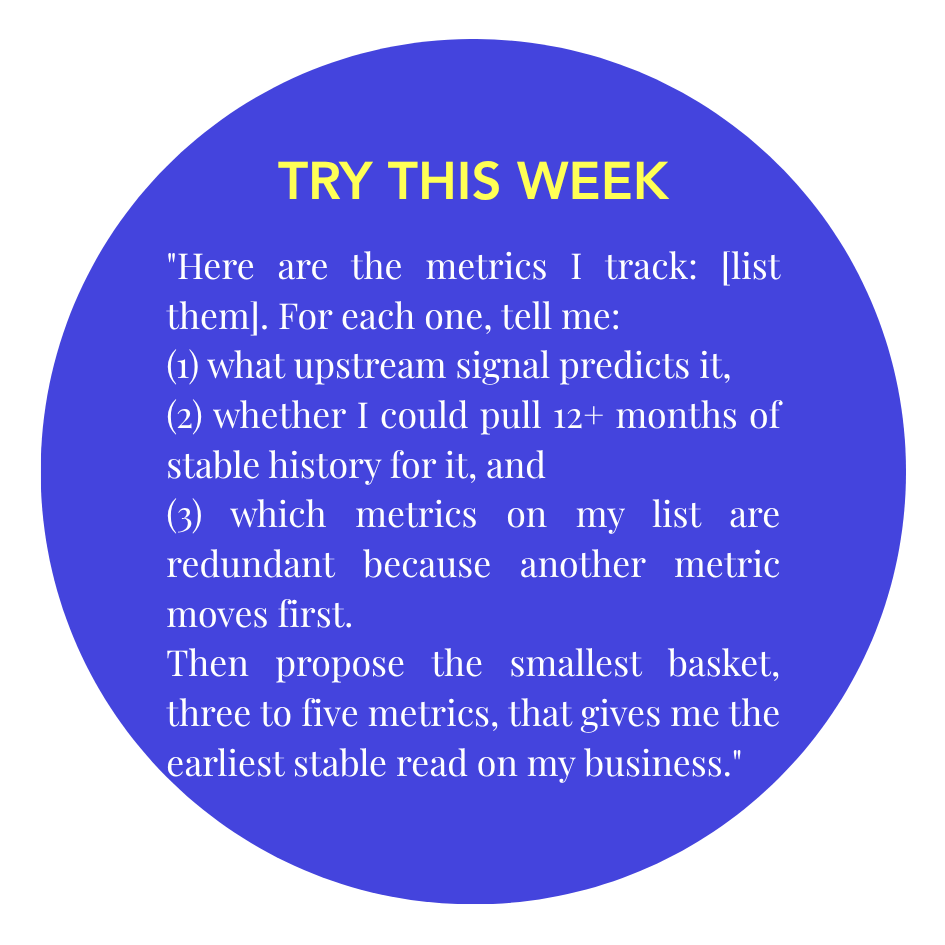
Go to your current favorite LLM with this:
Here are the metrics I track: [list them]. For each one, tell me: (1) what upstream signal predicts it, (2) whether I could pull 12+ months of stable history for it, and (3) which metrics on my list are redundant because another metric moves first. Then propose the smallest basket — three to five metrics — that gives me the earliest stable read on my business.
Delete what it tells you to delete. Read what's left one layer deeper, or all four layers of JERK.
The world isn't slowing down. But you can see its moves sooner.
Last week's JERK Workshop was my first. It's being revised, now cut into two, and on the website for the next version,
Footnotes
Brookings, "Around the halls: The cost of compromising federal data," December 2025.
Department of Labor response to Sen. Gallego, July 31, 2025.
BLS, CPI imputation tables, commodities and services survey.
BLS, "Notice of CPI collection reductions."
BLS statement, November 2025.
BLS Monthly Labor Review, "Counterfactual imputation approaches for the housing component of the October 2025 CPI," May 2026.
BLS statement, February 2026.
FESAC and BEA Advisory Committee terminated effective February 28, 2025; BLS advisory committees disbanded March 2025.
Reuters, August 1, 2025; AEA statement, August 1, 2025.
ASA, The Nation's Data at Risk 2025 report.
Check out the Jerk Report,
The JERK Report is a weekly signal read for small business owners. One signal. Four layers. A five-minute practice. Every Monday. From Rose Thun at Design Rosetta