- Jun 2
JERK Report #16 We've Seen This Movie: The AEO Gold Rush Is Following SEO's Exact Arc
Last week I told you the shortcut closed.
The old one — being big and broadly known — is losing its grip in the answer. What wins now is being the specific, genuinely-best answer to a real question.
This week, the other half of that story.
Because the shortcut closing hasn't slowed anyone down. It's set off a gold rush to sell you a new one.
I went looking for a simple tool to check whether AI was recommending my clients. I didn't find a tool. I found an industry.
More than $200 million has gone into these AEO tools by early this year. Paid use of them doubled in a single year. One of them raised twenty million dollars in June, thirty-five more by August, and has since closed a round valuing it at a billion. A category that barely had a name two years ago now has an industry leaderboard.
And a matching flood of articles. Search "best AEO tools" and you'll get a dozen near-identical ranked lists, most written this year, most quietly selling the tools they rank.
Here's the strange part.
All this got built and sold the same season Google published its first real guidance on showing up in AI answers — and listed the popular shortcuts it says don't work. The special files. The chopped-up content. The bought mentions. The schema games. ( https://developers.google.com/search/docs/fundamentals/ai-optimization-guide )
The articles kept selling them anyway. Open any "best AEO tools" list and you'll still find the same hacks Google just crossed off, recommended like nothing happened.
And the rawer hacks — the ones that game the answer directly — still work. For now.
A BBC reporter, Thomas Germain — tipped off by the SEO specialist Lily Ray that it was trivially easy — wrote one article on his own no-name site claiming he was the world's greatest competitive hot-dog-eating tech journalist. He made up the contest. Named himself the winner. Within a day, Google and ChatGPT repeated it as fact. It held for weeks. Google patched its policy. He found someone else running the same play the same day.
That's the trick working. And that's exactly the trap.
The one thing Google said does work: content with a real point of view. First-hand experience. Something only you could have written.
Everything else is rented. A position you have to defend every week isn't an asset. It's a liability with good SEO. You don't own it — you're leasing it from a landlord who's changing the locks in public.
We've seen this movie.
SEO ran this exact arc. An open frontier. Tricks that worked. A gold rush of tools and consultants selling rank-one shortcuts. Then Google changed the rules, and the shortcuts died overnight. The businesses left standing were the ones that had been genuinely useful the whole time.
That took fifteen years. AEO is running it in fast-forward — the patches land in weeks now, not years, because it's the same Google, and it already knows the playbook.
And the flood of tools isn't the start of the easy money. In SEO it was the end of it. The shortcut-sellers always show up when the window is most crowded and about to close.
Gaming a new channel is an arbitrage. Real money, for a while. Then the window closes — and it's closing faster this time. There's even a law for it. Goodhart's Law: when a measure becomes a target, it stops being a good measure. Every signal the engines use to decide who to cite gets gamed until it's worthless — so they change it, and the gamers start over. The people who win the next round aren't the ones who gamed the last one.
So here's the read.
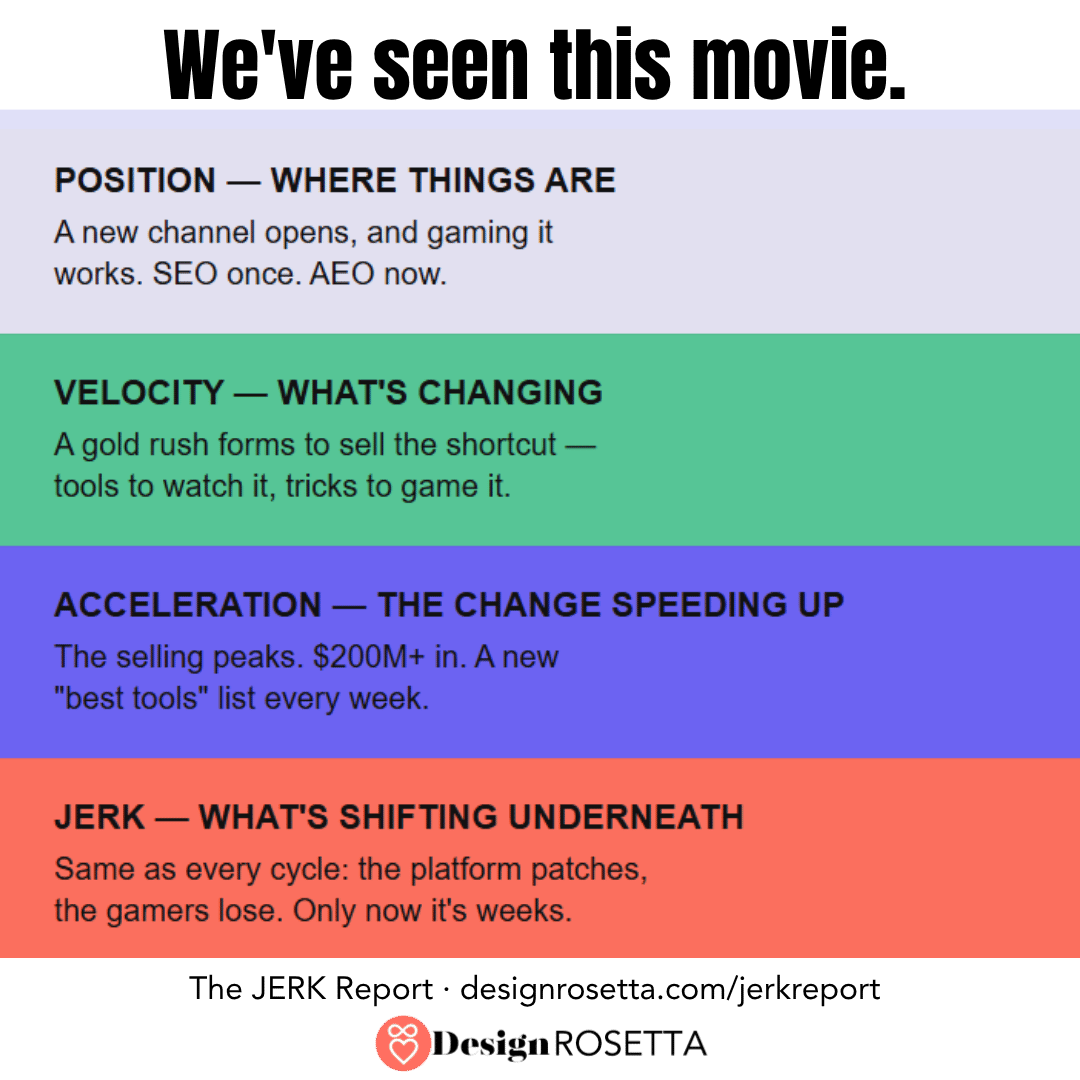
Position — a new channel opens, and gaming it works. SEO once. AEO now. AI-sourced traffic grew more than fivefold in a year.
Velocity — a gold rush forms to sell the shortcut. Tools to watch it. Tricks to game it.
Acceleration — the selling peaks. $200M+ in funding, a new "best tools" list every week, the hacks Google says to skip sold harder than ever.
Jerk — same as every cycle before it: the platform patches, the gamers get wiped, the genuinely useful survive. Only this time it's weeks, not years.
That last line is the signal. When the people selling the shortcut start outnumbering the people doing the work, the shortcut is already on borrowed time.
You don't need to buy your way into the answer. You don't need to trick your way in. Both are ways of not doing the work.
The work is the same as it was last week. Pick one question your buyer actually asks. Write the genuinely best answer to it that exists anywhere. Put it where the engines can read it.
That can't be gamed, because it isn't a game. It's the one position nobody can patch away.
We do this together at the AEO Workshop— find your buyer's real questions, write the first answers. Next ones: Thursday June 4 and July 9, noon–2 ET.
The work is the only thing you own. Go write the answer.
The five-minute practice: do the $200-million thing for free
Open one AI's chat box — ChatGPT, Claude, or Gemini. The front door.
Ask your buyer's real question: "Who's the best [your category] in [your town], and why?"
Write down who it names, and the reason it gives.
That check is what the funded tools are built to automate. You just did it in five minutes.
The part no tool does for you: make the reason it should name you true — and written down on your site.
The tools watch the score. The hacks rent it. Only the answer you write, you own.
Or if you’d like, join the AEO Workshop.
Check out the Jerk Report,
The JERK Report is a weekly signal read for small business owners. One signal. Four layers. A five-minute practice. Every Monday. From Rose Thun at Design Rosetta