- Sep 9
JERK Report #30 Limiting beliefs
Not applicable to this business?
I'm late with the JERK report, after Labor Day weekend. I was working on my JERK book. I also had dinner at a friend's house for Labor Day that has me thinking.
My friend was excited but fretting about how she is not a good enough cook to host. She realized that she could do a potluck or order in. We did a mix of both and the food was great. The conversation was even better.
I had told my friend that her frame of her cooking ability was entirely the wrong lens, it is her ability to pull together an amazing group of people that adore her and have wonderful debates that is a treasure no one else can create. The best meal in the world would not be as good as the conversation. She could serve pop tarts and we'd be delighted to be there.
The table was full of people with AI related PhDs; except for me, the slacker. The conversation kicked off about whether children should use AI in grade school. One man runs a non profit to teach kids about discernment, bias, AI use, by making generative art. Many at the table are wildly against the idea for many good reasons. I am not, but the differences of opinions reminded me of mindset differences I see in people I train. I was also thinking about the business version of my friend's I can't cook well framing.
What are our limiting beliefs that may or may not be true that keep us from opportunity?
Interestingly the Census Bureau measures something close related to AI.
Two questions
The Business Trends and Outlook Survey asks firms about their actual behavior and their beliefs about future use.
Did you use AI in the last two weeks?
Do you expect to use AI in the next six months?
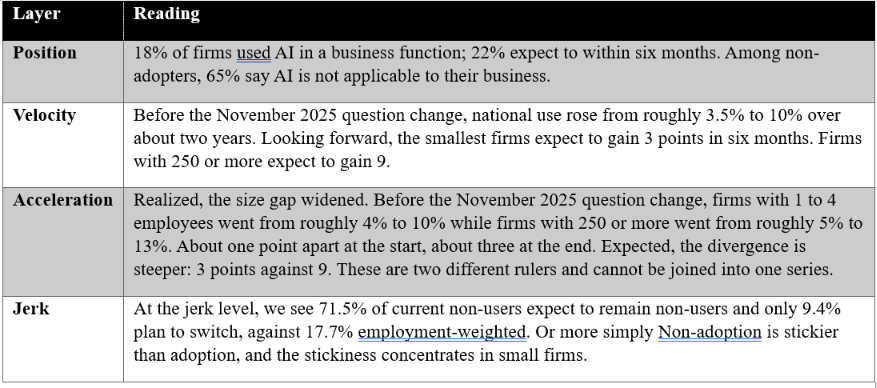
Nationally, 18 percent of firms used AI. 22 percent expect to within six months.[^1] Over time, the two lines move together, holding the same small gap. Firms are not over-promising.
While the Census Bureau has been surveying business owners for several years, they changed the questions On November 17, 2025. The old version asked whether a business used AI "in producing goods or services." The new version asks whether it used AI "in any business function." That is a wider net. Email drafting counts now. It did not before.
What small firms believe
Small firms are using AI less and expect to continue lagging behind.
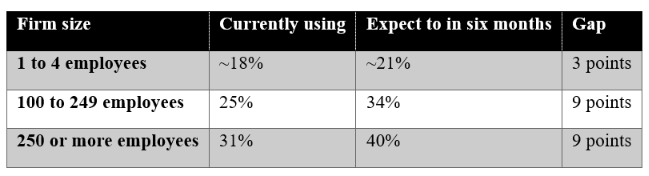
Firm-weighted, supplement period November 2025 to February 2026.[^2]
What the non-adopters believe
The Census supplement asks firms with no plans to adopt AI why not, these are their most frequent beliefs:
65% believe AI is not applicable to this business.
22% Lack of knowledge of AI capabilities
20% Privacy and security concerns[^3]
The Census authors call this a perceptual lag. Their words: the technology's utility keeps broadening across business functions while managerial awareness does not follow.
The stickiness
The supplement also lets you see who is about to move to adopt AI.
Among firms not currently using AI, 71.5 percent expect to still not be using it in six months. Another 19.1 percent do not know. Only 9.4 percent plan to switch.
Employment-weighted, that switching rate nearly doubles, to 17.7 percent.[^4]
The Census authors describe both adoption and non-adoption as characterized by significant inertia.
Larger firms flip at roughly twice the rate of the firm-weighted average. Most of the firms surveyed are smaller firms and they are least likely to begin.
Are those Census numbers right?
That was my first thought, as there are confusing bits in the report, and also because these values are far lower than much of the data I see.
Depending on which question you read in this survey, and how you weight it, this one dataset produces firm-level AI use anywhere from 17.9 percent to 32.0 percent, and employment-weighted rates from 31.2 percent to 54.0 percent.[^5]
The workers are ahead of the firms. Formal firm-level adoption sits at 17.9 percent. Worker task use sits at 22.6 percent. In 6.8 percent of firms, workers are using AI with no reported firm-level adoption at all.[^6] That shadow AI could be its own issue.
Ramp tracks AI adoption through corporate card spend rather than survey answers. Their March 2026 reading put business AI adoption at 50.4 percent, up from 35 percent a year earlier. Ramp counts businesses paying for at least one AI service, and its customer base skews toward mid-market and growth-stage firms, so it is not a national rate.[^7]
Section measures workers rather than firms. They find 5.5 percent of the workforce proficient, 73.5 percent using AI for basic one-off tasks, and 20.9 percent barely engaging. Section sells AI training, so read their proficiency bar accordingly.[^8]
The Census authors take this on directly. The Survey of Business Uncertainty reports 69 percent against their 18 percent. Most of that difference turns out to be sample composition: SBU surveys senior executives at large firms in AI-heavy sectors. Restrict Census to large firms in those same sectors and the two surveys broadly agree. About 75 percent of US firms have fewer than 10 employees, and that is what the national number is measuring.[^9]
The four layers
The five-minute exercise
Ask yourself:
1. If you've adopted AI, what did you say six months ago you would be doing with AI by now? Who in your firm does what tasks now with AI? How do those two compare? Extra credit: how do you know the quality and consistency of that AI output?
2. If you've not yet adopted AI, which of these census reasons have you said aloud in your business?
Too expensive
AI is not a mature enough technology yet
Lack of knowledge on the capabilities of AI
Concerns about privacy/security
Concerns about bias
Lack of skilled workforce
Lack of required data
Laws and regulations prevent or restrict use of AI
Previous or current use of AI did not meet expectations
AI is not applicable to this business
Of course, beyond the 5 minute exercise, limiting beliefs can be interesting to explore deeper with questions like
What do I believe?
Where did I get this belief?
Is it true or do I have any data to show it is not always true?
What benefit do I get from holding onto this belief or assumption?
Best wishes,
Rose
Notes
All figures from the primary source unless noted.
[^1]: Kathryn Bonney, Cory Breaux, Emin Dinlersoz, Lucia Foster, John Haltiwanger, and Aditya Pande, "The Microstructure of AI Diffusion: Evidence from Firms, Business Functions, and Worker Tasks," Center for Economic Studies Working Paper CES-26-25 (U.S. Census Bureau, April 2026), abstract, https://www.census.gov/library/working-papers/2026/adrm/CES-WP-26-25.html.
[^2]: Bonney et al., "Microstructure of AI Diffusion," sec. 3.3 and fig. 3.
[^3]: Bonney et al., "Microstructure of AI Diffusion," sec. 6 and fig. 19, based on BTOS Question 35.
[^4]: Bonney et al., "Microstructure of AI Diffusion," table 1a, panel B, and table 1b, panel B.
[^5]: Bonney et al., "Microstructure of AI Diffusion," table C.7.
[^6]: Bonney et al., "Microstructure of AI Diffusion," fig. 6, panel A.
[^7]: Ara Kharazian, "What Drives AI Adoption? Ramp AI Index April 2026 Update," Ramp, April 2026, https://ramp.com/data/april-2026-ai-index.
[^8]: Section, The AI Proficiency Report, https://www.sectionai.com/ai/the-ai-proficiency-report.
[^9]: Bonney et al., "Microstructure of AI Diffusion," sec. 9.
Image from Unsplash https://unsplash.com/@3tnik
Check out the Jerk Report,
The JERK Report is a weekly signal read for small business owners. One signal. Four layers. A five-minute practice. Every Monday. From Rose Thun at Design Rosetta